
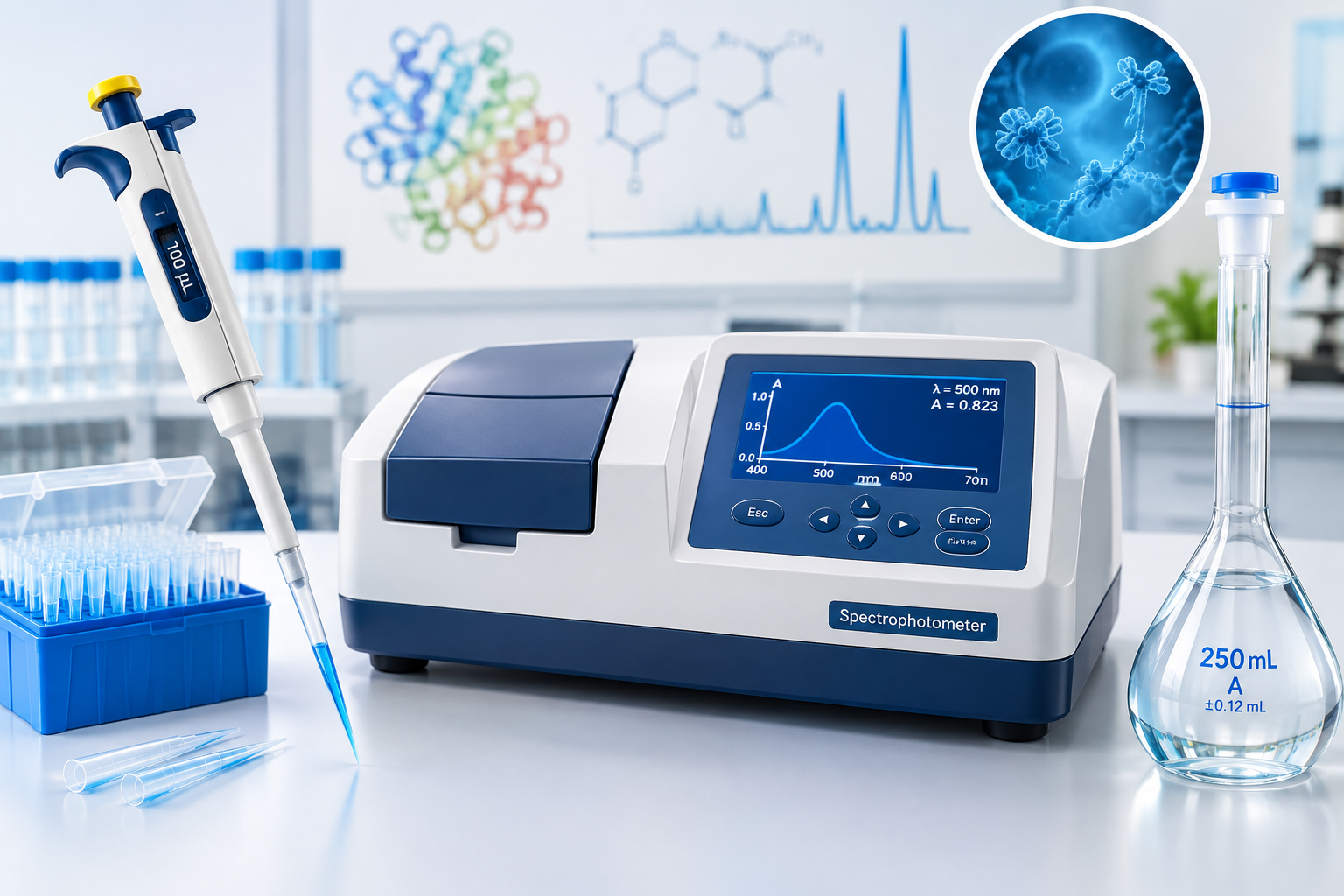
Analytical Biochemistry is a fundamental field of applied biochemistry concerned with the analysis, characterization, identification, and quantification of biochemical compounds. It brings together analytical principles and instrumental techniques to obtain qualitative and quantitative information about biological substances.
This course, intended for Master 1 students in Applied Biochemistry, focuses on the fundamental principles and applications of major spectroscopic methods used in biochemical analysis. It introduces the interaction between electromagnetic radiation and matter and the principles underlying spectroscopic measurements.
The course is organized into three main chapters covering Ultraviolet–Visible (UV–Vis) spectrophotometry, Infrared (IR) spectroscopy, and Nuclear Magnetic Resonance (NMR) spectroscopy. Particular attention is given to instrumentation, spectral data acquisition, and the analysis and interpretation of spectra.
The course also includes practical work, application workshops, and scientific field trips, allowing students to connect theoretical concepts with practical applications and to develop their analytical skills. Through these activities, students are expected to progressively develop their ability to analyze spectroscopic data and apply spectroscopic methods to biochemical compounds, with applications in biology and medicine.
Overall, this course aims to provide students with the theoretical knowledge and practical skills necessary to understand and use spectroscopic techniques in qualitative and quantitative biochemical analysis.